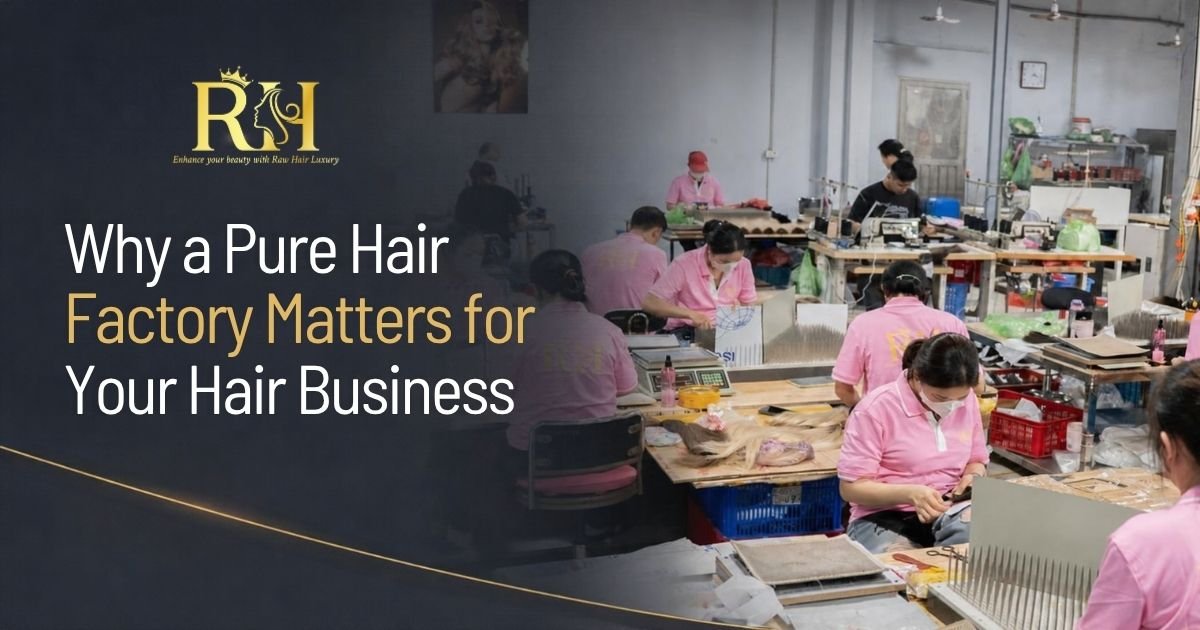


Vietnamese hair and Cambodian hair both come from Southeast Asian donors and share the same thick, round, high-strength fiber structure dermatologists classify as Asian hair. The real difference isn’t biology. Vietnam has a far larger raw material base and export market, and in both countries, the grade of a specific bundle, raw, virgin, Remy, or non-Remy, matters more to how it performs than the country printed on the label.
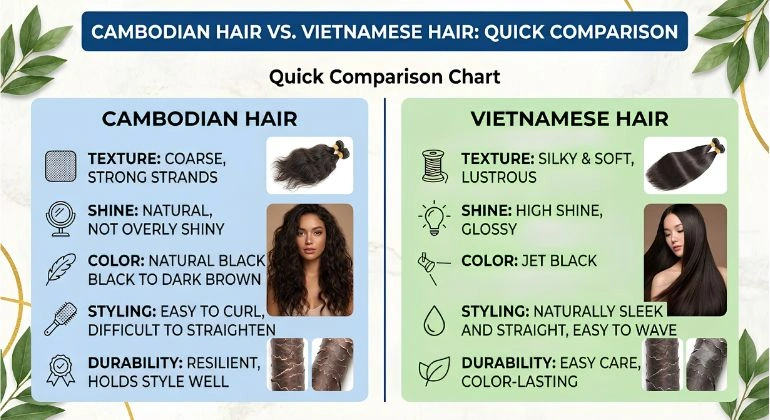
Cambodian Hair vs Vietnamese Hair: Quick Comparison
| Factor | Cambodian Hair | Vietnamese Hair |
| Donor population | ~18 million (Khmer majority) | ~102 million |
| Fiber structure | Asian hair type: thick cuticle, round cross-section | Asian hair type: thick cuticle, round cross-section |
| 2025 global export rank (human-hair wigs/extensions) | Not in top 15 | 5th ($20.8M, up 636% since 2021) |
| Natural texture on the donor | Straight to loosely wavy, slightly coarser strand feel reported by vendors | Straight to wavy, reported as finer strand feel |
| What drives lifespan | Grade (raw/virgin vs. non-Remy), not country | Grade (raw/virgin vs. non-Remy), not country |
Where Does Each Hair Type Come From?
Cambodian hair is collected primarily from Khmer donors, who make up about 95% of Cambodia’s population of roughly 18 million people. Vietnamese hair is collected from Vietnamese donors across a population of about 102 million, nearly six times larger. That population gap shows up directly in trade volume. According to 2025 trade figures compiled from Trade Map and reported by World’s Top Exports, Vietnam ranked 5th worldwide among exporters of human-hair wigs, beards, and eyelashes by value, shipping roughly $20.8 million worth of product, a 636% increase since 2021. Cambodia did not rank among the top 15 exporting countries in that same human-hair category during 2025.
That gap explains a practical difference buyers notice: Vietnamese raw hair is easier to source consistently in bulk, in a wider range of lengths, than Cambodian hair. It does not mean Cambodian hair is lower quality. It means fewer factories are working with a smaller domestic supply, so lead times and available stock vary more.
Is Cambodian Hair Structurally Different From Vietnamese Hair?
Dermatology research has not documented a structural difference between the two. A peer-reviewed review published in Clinical, Cosmetic and Investigational Dermatology found that Asian hair carries a thicker, more compact cuticle layer than Caucasian hair and generally shows the strongest mechanical properties among the major ethnic hair categories studied [1]. Cross-section research summarized by the International Society of Hair Restoration Surgery reports that Asian hair fibers appear circular in cross-section and run larger in diameter than African or Caucasian hair [2].
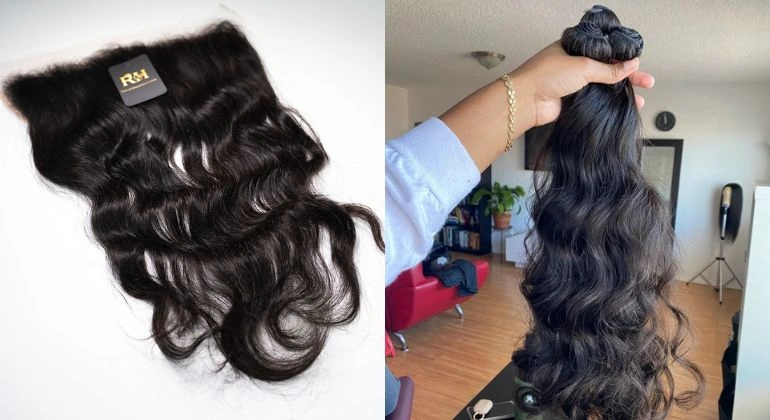
Both Vietnamese and Khmer donor populations fall within that same Asian hair classification. The strand itself does not carry a passport. What separates one vendor’s “Cambodian hair” from another’s “Vietnamese hair” in practice is nearly always collection method and processing, covered next, not an underlying biological difference between the two donor groups.
Sourcing Ethics: What the Reporting Shows
Origin claims in this niche get repeated without sourcing more often than almost any other detail. Journalism backed by the Pulitzer Center found that women in rural Cambodia are typically paid around $15 for a ponytail of hair sold into the export market, while reporting cited by The ASEAN Post found Vietnamese sellers interviewed were sometimes paid under $3 for their hair domestically [3]. Separate field reporting compiled by the Borgen Project documents similar accounts from Cambodian sellers who regret the price they accepted. Neither figure is regulated or independently audited at the donor level in either country.
A country name on a product listing certifies nothing about how ethically that specific batch was sourced. A supplier’s ability to document donor count, collection practices, and how long they’ve worked in a region tells a buyer far more than which nation appears in the title.
The Grade Matters More Than the Country
Every hair vendor sells “virgin” or “100% human hair.” Those words describe almost nothing on their own. The industry separates hair into four processing grades, and this classification cuts across both Cambodian and Vietnamese origin:
| Grade | Donor count | Cuticle | Chemical processing |
| Raw hair | Single donor | Fully intact, naturally aligned | None, not even steaming |
| Virgin hair | Usually single donor | Intact and aligned | None |
| Remy hair | One or more donors | Intact, mechanically aligned | May be colored or steam-textured |
| Non-Remy hair | Mixed, uncontrolled | Stripped in an acid bath | Coated in silicone to fake smoothness |
Non-Remy hair passes the in-store touch test, then the silicone washes out within a handful of shampoos, leaving bare, unaligned strands that tangle and shed fast [4]. A bundle sold as “Cambodian” can be non-Remy. A bundle sold as “Vietnamese” can be non-Remy too. Ask about grade before you ask about country, and a serious supplier will answer without hesitation. See our own Raw SEA Straight Bundle or the Raw SEA Wavy Bundle for what single-donor, cuticle-aligned raw hair looks like on a spec sheet.
Price and Lifespan: What to Expect
Published price comparisons between “Cambodian hair” and “Vietnamese hair” rarely hold up, because they compare listings without confirming grade, length, or donor count. Two bundles both labeled 12-inch, 100g, double-drawn can differ in price by 3x depending on whether one is raw single-donor and the other is non-Remy. For reference, a natural-color raw Vietnamese bundle at Raw Hair Luxury currently runs $62 to $185 depending on length and drawing, a real, verifiable price point rather than a market-wide average.
Lifespan follows the same logic. Properly maintained single-donor raw or virgin hair, regardless of whether it came from Cambodia or Vietnam, is commonly reported to last one to three years with good care [5]. Non-Remy hair, once its silicone coating washes out, typically degrades within months. Ask a vendor for their grade and care instructions before you ask which country to trust more.
Which One Should You Choose?
If you run a salon or resale business and need consistent bulk stock in a wide range of lengths, Vietnam’s larger supply base and export infrastructure make sourcing more predictable. If a client specifically wants the slightly coarser, wavy texture some vendors report from Cambodian donors, and you can verify the supplier’s grade claims, Cambodian hair remains a legitimate option. Either way, confirm raw or virgin, single-donor status before you confirm country. That single question filters out more low-quality stock than any origin debate does.
Where to Buy Verified Raw Vietnamese Hair
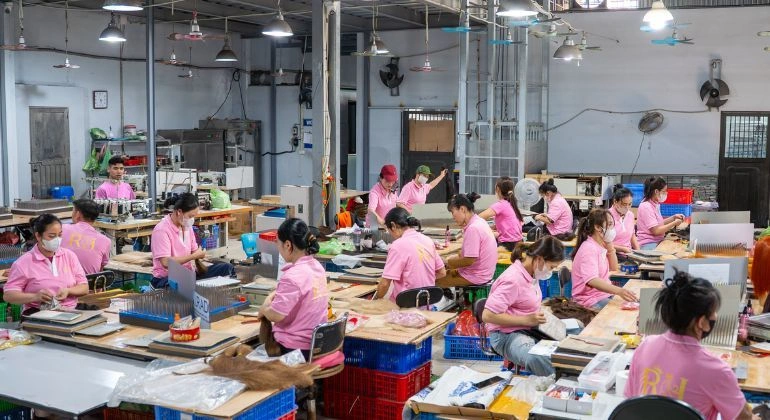
Raw Hair Luxury has sourced directly from Vietnamese donors for more than 10 years, supplying stylists, salons, and resellers across the US. Every bundle in our shop is single-donor, cuticle-aligned raw hair, not relabeled non-Remy stock. Learn more about how we source on our company page, and if you’re deciding between application methods once your hair arrives, our guide to clip-in vs. tape-in extensions covers that next step.
Ready to see the difference single-donor raw hair makes? Contact Raw Hair Luxury for a consultation on which grade and texture fit your clients, or browse verified raw Vietnamese bundles in our shop.
Ready to find your perfect match? Contact us today for expert advice and exclusive discounts on premium human hair extensions.
📲Phone/WhatsApp: +1 (206) 698‑5133
🛜Instagram: RAW HAIR LUXURY COMPANY
🌐Tik Tok: RAW HAIR LUXURY
📧 Email: Rawhairluxury.us
🌐Website: rawhairluxury.com