
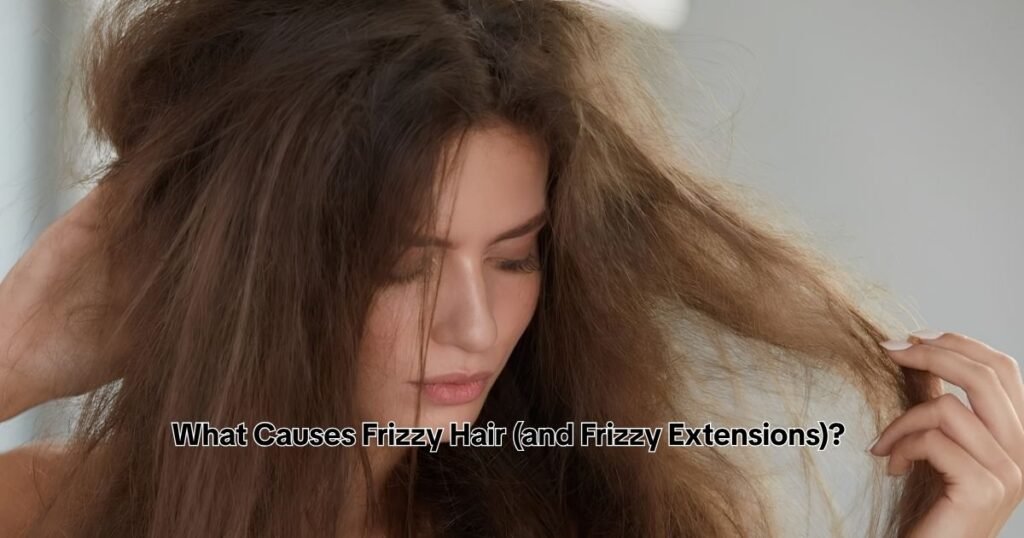
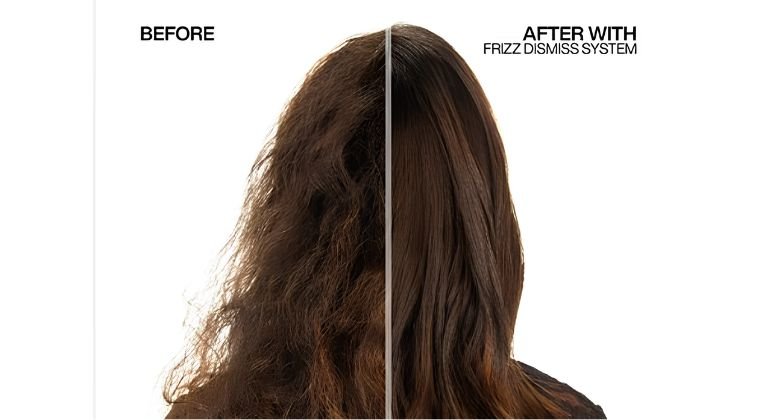
Frizzy hair happens when the outer cuticle layer of a hair strand lifts away from the shaft, letting moisture from the air push into the cortex underneath and swell it unevenly. The result is a strand that stands away from its neighbors instead of lying flat against them. Natural hair and hair extensions frizz for the same underlying reason, but they don’t frizz at the same rate, and the difference matters more than most guides admit: a Remy extension and a non-Remy one can react to the exact same humid room in opposite ways.
What Is Frizzy Hair, Exactly?
Every strand of hair is built in three layers. The medulla sits at the center, a thin core that only thicker hair types actually have. The cortex, a bundle of keratin protein filaments, makes up most of the strand and gives it strength and shape. The cuticle wraps around both like a layer of overlapping scales, similar to shingles on a roof.
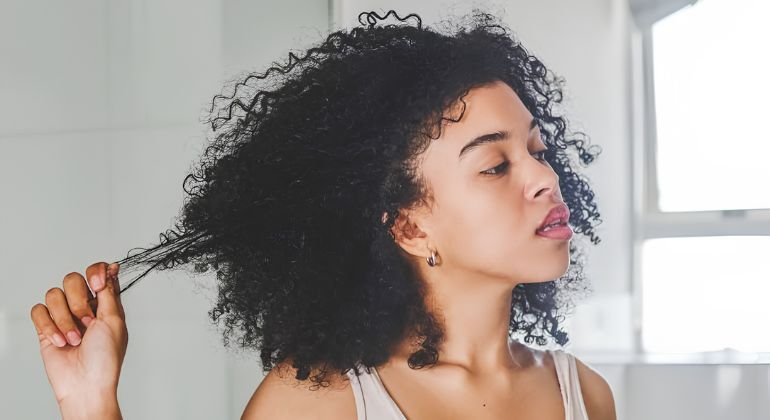
When those scales lie flat, they seal the cortex and keep it stable. Water can’t easily get in or out. When they lift, whether from a blow dryer, a bleach job, or a rough towel, the cortex becomes exposed. Humid air pushes water molecules into the gaps, and the strand swells, not evenly across the head, but strand by strand, in whatever direction each individual cuticle happens to be open. That uneven swelling is what shows up as frizz: a rough, staticky texture instead of a smooth, unified shape.
What Causes Frizzy Hair?
Frizz has one mechanical cause, a lifted cuticle absorbing water unevenly, but several different things can lift that cuticle in the first place.
Humidity is the most common trigger and the hardest to control. When the air holds more moisture than the hair does, water moves toward the hair to balance things out, the same way a dry sponge pulls water off a wet counter. Hair with a compromised cuticle absorbs that moisture fast and swells unevenly.
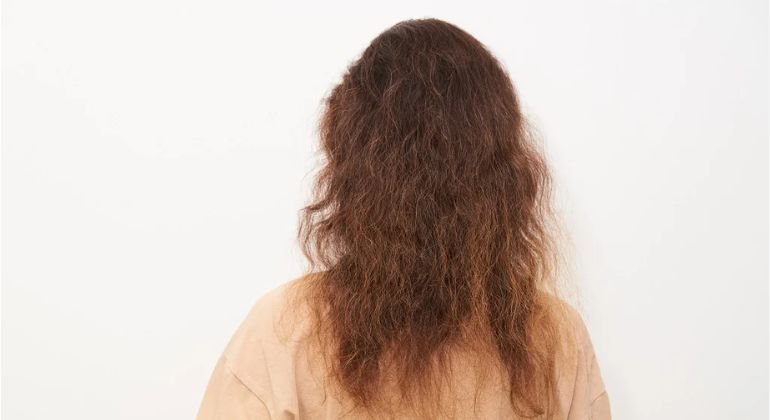
Heat styling is close behind. Flat irons and blow dryers above roughly 350°F can soften the keratin bonds that hold cuticle scales flat, especially without a heat protectant. This risk climbs sharply for processed or non-Remy wigs, since a stripped cuticle has far less structure left to protect. Chemical processing, bleach, relaxers, and perms does the same thing through a different mechanism: it forces the cuticle open with high-pH chemistry so color or texture can reach the cortex, and the scales don’t always close back down completely afterward.
Mechanical stress adds up quietly. Rough towel-drying, brushing dry hair, and sleeping on cotton pillowcases all create friction that chips at cuticle scales over months, without any single dramatic event causing it.
Genetics plays a role too, particularly for wavy, curly, and coily hair, where the strand bends instead of growing straight. At every bend, the cuticle scales can’t lie perfectly flat, which is part of why curl patterns are naturally more frizz-prone even with zero damage. The AAD recommends gentle towel-drying and conditioning after every wash as two of the simplest ways to keep the cuticle intact regardless of hair type.
Why Hair Extensions and Wigs Frizz Differently Than Natural Hair
Natural hair and hair extensions frizz for the same underlying reason, an open cuticle absorbing moisture, but extensions carry one variable natural hair doesn’t have: the hair was collected from a donor, processed by a manufacturer, and sold to you weeks or months before it ever touched your head. Whatever happened to the cuticle during that process decides how the hair behaves in a humid bathroom long before you do anything to it. This is the part of the frizz conversation most hair-care guides skip entirely, and it’s the part that matters most if you’re buying hair extensions or a wig rather than just managing what grows out of your own scalp.
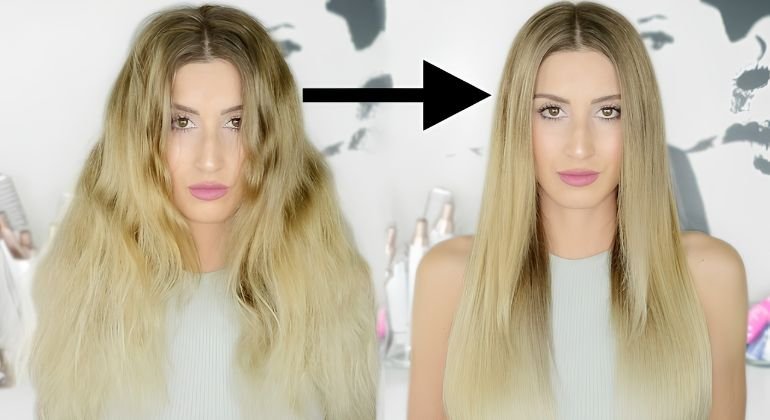
Raw hair, hair that has never been steamed, chemically processed, or acid-treated, keeps its cuticle intact from donor to install. Because the cuticle was never stripped, there’s no silicone coating masking damage underneath it and no first-wash reveal waiting to happen. It isn’t a different kind of chemistry. It’s the same 18-MEA lipid layer and hydrogen-bond structure described earlier, just preserved instead of destroyed during manufacturing. Vietnamese raw hair in particular tends to hold up well against frizz because it’s naturally straight and dense enough that manufacturers rarely need to chemically process it to get a sleek finish in the first place.
| Hair Grade | Cuticle State | Frizz Resistance | After 3-5 Washes | Typical Lifespan |
| Raw | Fully intact, never processed | Highest | No change; texture stays as it grew | 3-5 years |
| Remy (processed) | Intact, aligned root-to-tip | High | Minor softening; stays smooth | 1-2 years |
| Virgin | Intact, but steam-processed for texture | Moderate to high | Slight texture relaxation | 1-2 years |
| Non-Remy | Stripped or mixed-direction | Low | Silicone washes off; frizz and tangling appear | A few months to under a year |
How to Test Hair for Frizz Resistance Before You Buy
You don’t have to take a supplier’s word for cuticle quality. Three simple tests, the kind salon owners and distributors run before committing to a bulk order, reveal it directly.
The wash test. Run a small section of hair under water and lather with a basic, non-conditioning shampoo. Let it air dry with no serum, oil, or leave-in product. If the cuticle is intact and aligned, the section dries smooth with a natural wave or straightness. If it dries into a puffball, tangled mat, or straw-like texture, the cuticle was stripped, and any shine you saw at unboxing was very likely a silicone coating rather than the hair itself.
The burn test. Pull a few loose strands and burn them carefully over a sink or non-flammable surface. Genuine human hair burns slowly, smells like burnt hair, and leaves a soft ash. Hair blended with synthetic fiber melts into a hard bead and smells like burning plastic, a sign the bundle isn’t 100% human hair regardless of what the listing claims.
The direction test. Take a strand from root to tip and run your fingers down it, then back up. Aligned Remy or raw hair feels smooth in both directions. If it catches or feels rough going one way, the cuticles inside that bundle point in mixed directions, which predicts tangling and frizz well before the hair sees a shower.
How to Fix and Prevent Frizzy Hair
Whether the frizz is coming from your natural hair or from an installed set of extensions, the fix follows the same two rules: keep the cuticle sealed, and stop adding the stress that lifts it back open.
Start in the shower. Wash with lukewarm water rather than hot, since heat is what forces the cuticle open in the first place, and finish with a cool rinse to help the scales lie back down. A sulfate-free shampoo cleans without stripping the natural oils that keep the cuticle sealed, which matters even more for extensions, since they aren’t getting fresh sebum from a scalp to replace what washing removes.
Detangle before water touches the hair, not after. Wet hair, and especially wet extension hair, is at its weakest point, and pulling a brush through a wet tangle is one of the fastest ways to lift cuticle scales and create the exact frizz you’re trying to avoid. A wide-tooth comb or loop brush, worked from the ends upward, prevents most of that damage.
Skip the daily wash. Extensions and wigs don’t need it, since they aren’t producing scalp oil, and over-washing strips cuticle-sealing lipids faster than they can regenerate. Most human hair extensions do better on a wash every one to two weeks, adjusted for buildup, paired with the right hair care products for the routine in between.
Sleep on silk or satin instead of cotton. Cotton pulls moisture out of the hair and creates friction all night, both of which work against a sealed cuticle.
For extensions specifically, the fix starts earlier than washday. The single best defense against frizz in wefts, wigs, and clip-ins is buying hair where the cuticle was never stripped to begin with, since no amount of careful aftercare fully undoes what a silicone coating was hiding underneath.
The Bottom Line
Frizz is a cuticle problem before it’s anything else, whether the hair in question is growing out of your scalp or installed as a weft. Humidity, heat, and chemical processing all attack the same protective layer, and once it’s compromised, the hair starts behaving unpredictably in exactly the conditions you can’t control. For extensions and wigs, the fix starts at the sourcing stage, not the styling routine: hair with an intact, aligned cuticle resists frizz because there’s nothing hidden underneath a coating to reveal later.
If you’re sourcing wholesale and want hair that won’t reveal a frizz problem three washes after your client leaves the chair, Raw Hair Luxury’s raw hair bundles and wigs keep their cuticle intact from donor to delivery. Request a sample pack and run the wash, burn, and direction tests yourself before committing to a bulk order.
Ready to find your perfect match? Contact us today for expert advice and exclusive discounts on premium human hair extensions.
📲Phone/WhatsApp: +1 (206) 698‑5133
🛜Instagram: RAW HAIR LUXURY COMPANY
🌐Tik Tok: RAW HAIR LUXURY
📧 Email: Rawhairluxury.us
🌐Website: rawhairluxury.com