
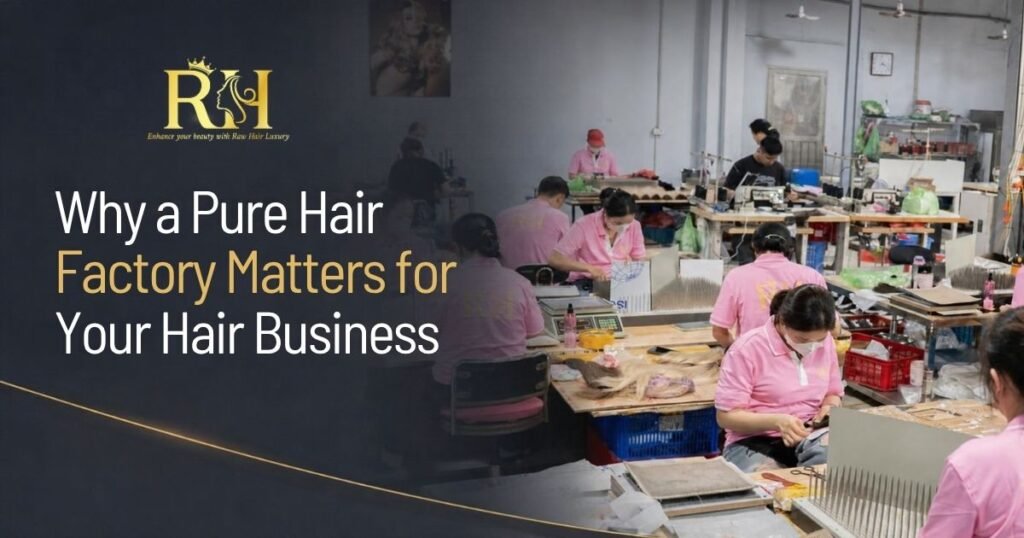
A pure hair factory processes 100% human hair under its own roof, from sorting raw ponytails to sewing the final weft, instead of reselling bundles from other workshops. That control decides three things for your hair business: whether your next order matches your last one, whether you can prove the hair’s origin at US customs, and whether the “virgin hair” claim on your packaging holds up.
If you run a salon, sell under your own label, or resell bundles, you carry the cost when a batch sheds, tangles, or gets held at the port. Use the comparison, the legal context, and the 7-step checklist below before your next wholesale order.
What Is a Pure Hair Factory?
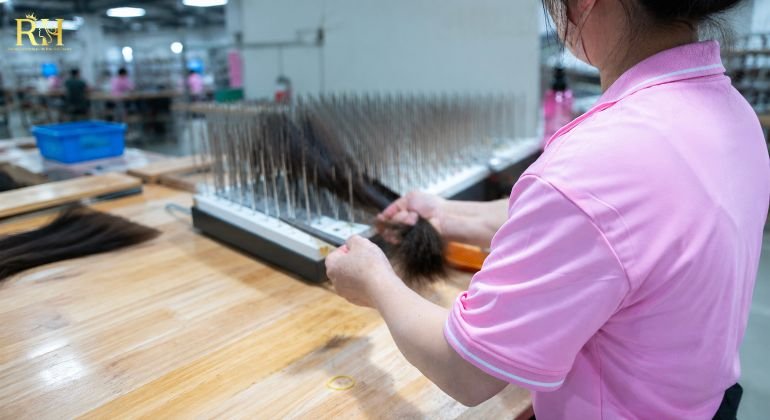
A pure hair factory is a hair extension manufacturer that sells only 100% human hair and runs its own processing line. “Pure” means no synthetic fiber or animal hair in the bundle. “Factory” means the company sorts, cleans, draws, and wefts the hair itself.
Neither word tells you the grade, and grade sets lifespan and price:
- Raw hair: one donor or a matched group, cuticles intact and facing one direction, no chemical processing.
- Virgin hair: never colored or permed, cuticles aligned. Some suppliers steam it to set a wave.
- Remy hair: cuticles aligned root to tip, but the hair may be colored or textured.
- Non-Remy hair: cuticles mixed or stripped, then acid-treated and silicone-coated.
Origin does not set grade either. A Vietnamese hair factory, an Indian temple-hair processor, and a Chinese workshop can each sell all four grades on different lines. Ask which grade your order comes from, and see our guide to raw hair for what separates raw virgin hair from the rest.
Pure Hair Factory vs Trading Company: Which Wholesale Hair Supplier Controls Quality?
A human hair factory controls raw material, processing, and batch records. A trading company buys finished bundles from several workshops, so it controls price and packaging but not what happens to the hair before it arrives. Plenty of traders call themselves factories online, which is why the checklist further down exists.
| Factor | Pure hair factory | Trading company | Dropship reseller |
| Who processes the hair | In-house team | Outside workshops, often several | Unknown to you |
| Batch consistency | One sorting and wefting standard | Depends on which workshop filled the order | Unpredictable |
| Custom length, density, color | Adjusted on the line | Limited to workshop stock | Catalog only |
| Documents you can request | Collection region, processing records, export papers | Invoices; origin often unclear | Rarely any |
| Price layers | Factory margin | Factory + trader | Factory + trader + reseller |
| When a batch fails | Traces the lot and fixes the step | Returns to the workshop, if it knows which | Refund at best |
Factory-direct hair extensions cost less because you skip margin layers. The last row matters more for a growing business: when a supplier can trace a complaint to a lot number, you get a fix instead of a refund, and your clients get the same hair twice.
Why Quality Control Starts on the Factory Floor
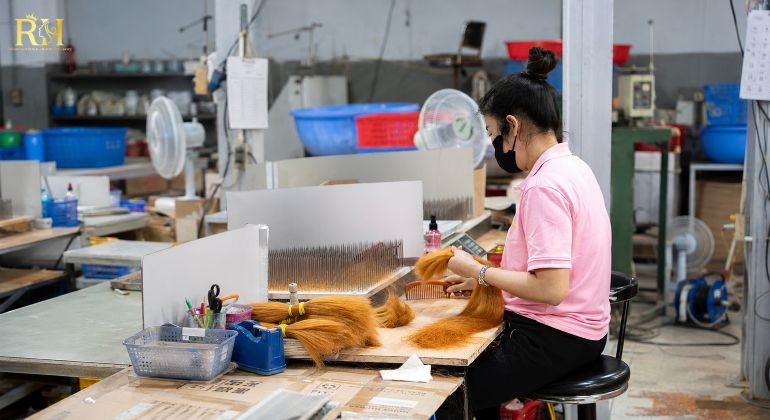
Aligned Cuticles Decide How Long Remy Hair Lasts
Each strand wears an outer cuticle of overlapping scales. A review in the International Journal of Trichology (Gavazzoni Dias, 2015) reports that Asian hair carries 6 to 8 cuticle layers, more than Caucasian or African hair. When every strand in a bundle points root to tip, those scales lie flat. When strands face both ways, the scales catch and the weft mats.
Workshops that buy mixed-direction hair strip the cuticle in an acid bath, a common trade practice, then coat the strands. The same review explains that alkaline treatments reduce the lipid layer that keeps hair water-resistant, and that silicones such as dimethicone cut friction on damaged hair. That coating is why a non-Remy bundle feels silky in the showroom and tangles after a few washes. Only the team handling the hair from sorting onward knows whether a bundle kept its cuticles.
Trade Data Shows How Wide “100% Human Hair” Runs
We ran the unit values from World Bank WITS export data for 2024 under HS code 6703 (worked human hair):
- India: $574.4 million across 4.75 million kg, about $121 per kg
- China: $209.2 million across 2.79 million kg, about $75 per kg
- Myanmar: $54.8 million across 5.22 million kg, about $10.50 per kg
The code also covers some animal and textile fibers prepared for wigs, so read these as a rough signal. Still, an eleven-fold gap in unit value shows that “human hair” on an invoice can mean anything from sorted donor ponytails to tangled combed hair. A factory that buys and sorts its own raw material can tell you which one you are paying for.
Supply Chain Transparency Protects You at US Customs
If you import hair into the United States, you answer for where it came from. In July 2020, US Customs and Border Protection detained nearly 13 tons of hair products worth more than $800,000 from Lop County Meixin Hair Product Co. at the Port of New York/Newark, under a Withhold Release Order based on 19 U.S.C. 1307, the statute that bars goods made with forced labor.
Since June 21, 2022, the Uyghur Forced Labor Prevention Act presumes goods made wholly or in part in Xinjiang are prohibited unless the importer proves otherwise with clear and convincing evidence. A trader that blends lots from several workshops rarely offers that level of supply chain transparency. A pure hair factory that processes its own hair can hand you the collection region, processing records, and export documents that answer a CBP inquiry. Keep them on file for every shipment, and ask a licensed customs broker what your imports require.
How to Verify a Pure Hair Factory in 7 Steps
Most of these checks take a day or two and cost less than one bad shipment.
- Ask for a live video walk-through. Request an unscheduled call from the floor showing sorting, drawing (removing short hairs), and wefting. Traders tend to show a showroom or stock footage.
- Check registration and export history. Ask for the registration certificate and a recent export record, and match the address to the site you saw on video.
- Sample from a production lot. Get the lot number and place your bulk order from the same or a matched lot.
- Burn a few strands. Human hair singes, smells like burnt protein, and leaves crumbly ash. Synthetic fiber melts into hard beads.
- Wash the sample five times. Coated non-Remy hair loses its slip and tangles at the nape as the silicone washes out.
- Rub a single strand. Slide your fingers from tip toward root. Aligned cuticles feel slightly rough that way and smooth the other way. Equal smoothness both ways suggests stripped or coated cuticles.
- Compare two orders. Weigh bundles (100 grams is the common standard), measure length, and check color in daylight against the first shipment. Log the results so you can hold the supplier to them.
Need a raw hair factory shortlist to test? Start with our roundup of wholesale Vietnam hair vendors for raw hair.
The Bottom Line for Your Hair Business
A pure hair factory gives you control over grade, records that answer customs and advertising questions, and orders that match from one season to the next. Add your own testing, and the “raw” or “virgin” on your label becomes a claim you can defend.
Raw Hair Luxury supplies salons and hair brands with. Learn more about our company and how we grade each bundle.
Test us before you trust us. Request a sample bundle, run it through the 7-step checklist, and compare it with your current wholesale hair supplier. Contact our wholesale team for sample pricing and lot details.
📲Phone/WhatsApp: +1 (206) 698‑5133
🛜Instagram: RAW HAIR LUXURY COMPANY
🌐Tik Tok: RAW HAIR LUXURY
📧 Email: Rawhairluxury.us
🌐Website: rawhairluxury.com