

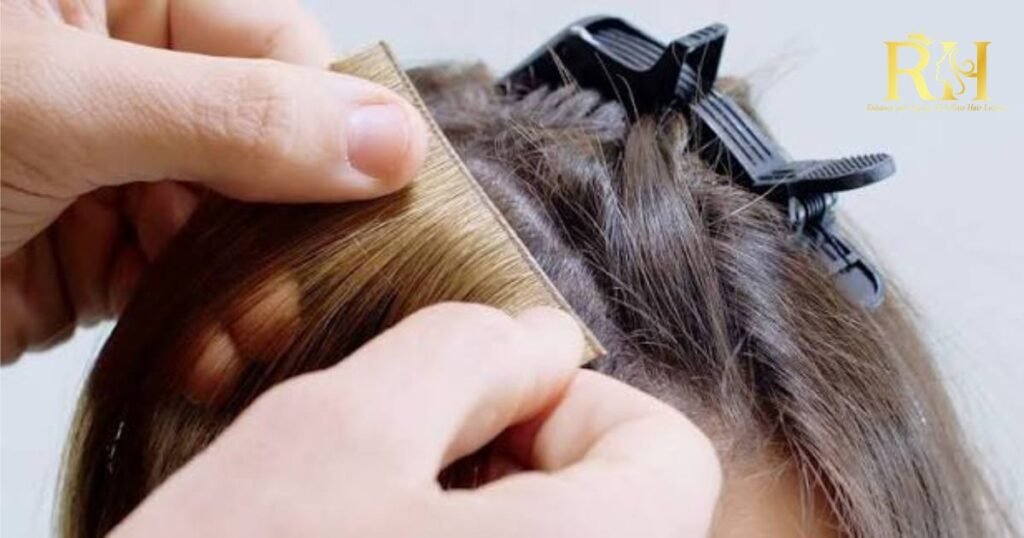
Your client ties her hair up for the gym two weeks after install, and a friend spots the tape tab above her ear. The photo lands in your inbox, and you risk losing the rebook along with the review. Below you get a seven-method comparison, six placement rules, the limits dermatologists set, and a five-minute check to run before every client leaves.
Why Do Visible Extension Tracks Show?
Tracks show when the attachment is thicker than the hair covering it, sits too close to a hairline or part, drops lower with grow-out, or frizzes while the client’s own hair stays smooth.
- Bulk. A standard tape tab or a double-stitched machine weft adds a ridge. Thin, low-density hair cannot cover that ridge once it moves.
- Placement. A bond set inside the border of the hairline or part shows the moment the client changes her style.
- Grow-out. Scalp hair grows about 0.2 to 0.7 inches a month, according to The Trichological Society figure cited by Medical News Today. By week eight, a bond placed tight to the scalp can hang from about a third of an inch to more than an inch lower. Lower bonds lift out when hair goes up.
- Hair quality. Hair with cuticles running in mixed directions mats around the bond. A 2009 British Journal of Dermatology report recorded matting as an extension complication, and a matted clump is the easiest track to spot.
Which Invisible Hair Extensions Hide Best? A Method Comparison
For most clients, invisible tape-in extensions and genius or hand-tied wefts give the flattest profile. Micro I-tips suit clients who wear high ponytails daily, because each bond is small and you can place it anywhere under the canopy.
| Method | Attachment profile | Hides in a high ponytail? | Best client | Typical move-up |
| Regular tape-in | Wide, glossy tab with a visible edge | Poor | Medium to thick hair, loose styles | 6 to 8 weeks |
| Invisible (injection) tape-in | Thin tab; hair exits the base like natural growth | Fair to good | Fine hair, clients who switch parts | 6 to 8 weeks |
| Machine weft | Thick stitched seam | Poor | Thick hair, maximum volume | 6 to 8 weeks |
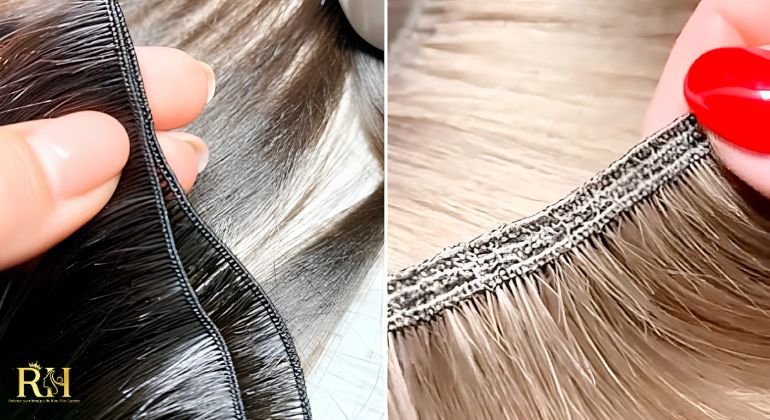
| Hand-tied weft | Thinnest, most flexible track; unravels if cut | Good | Fine to medium hair, beaded-row installs | 6 to 8 weeks |
| Genius weft | Thin, flat track you can cut anywhere | Good | Custom-width rows, narrow heads | 6 to 8 weeks |
| Micro I-tip / micro-link | One small bead per strand | Very good | Daily ponytail and updo wearers | 6 to 12 weeks |
| Seamless clip-in | Flat silicone or PU base | Fair | Events, first-time extension clients | Removed daily |
Move-up ranges reflect common salon practice. Follow the manufacturer’s guidance and the client’s own grow-out rate.
Invisible Tape-In Extensions for Fine Hair
Injection tape-ins suit thin, low-density clients because the tab is thinner and the hair leaves the base at the root, so a flipped part shows scalp instead of a shiny edge. For very fine sections, pair one extension with a blank tape to halve the weight. Our breakdown of regular vs. invisible tape-in extensions covers tab construction in more detail, and our guide to how long tape-ins last helps you set the rebook date.
Genius Weft vs. Hand-Tied Weft for Volume Clients
Hand-tied gives you the thinnest track, but it unravels if you cut it. A genius weft sits almost as flat and you can cut it to any width, which helps on narrow heads and near the temples. Keep machine weft for thick hair that can bury the seam. See our complete guide to weft hair extensions for row counts by density.
Alt text: “Genius weft and hand-tied weft tracks compared for thickness and flexibility.”
Why Raw Human Hair Keeps Extensions Undetectable
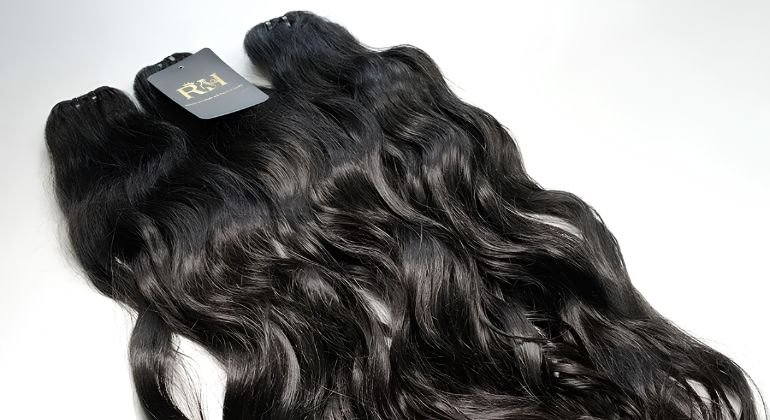
Hair grade decides whether the blend survives the first month of washing. Raw and Remy hair keep cuticles aligned root to tip, so strands lie flat against the client’s own hair. Non-Remy hair relies on a silicone coating that washes out, and the hair then swells and tangles near the bond.
The grade scale runs raw, then virgin, then Remy, then non-Remy. Raw hair comes from one donor with no chemical processing, so it behaves on wash ten the way it did on wash one. Non-Remy hair gets acid-stripped, then coated to shine in the pack. When the coating washes out, a frizzy band forms along the attachment line, right where you tried to hide the bond. Undetectable hair extensions start with the grade, before any install technique. Read our guide to raw hair and our checklist of key features of high-quality extensions before you choose a supplier.
Invisible Extensions and Traction Alopecia: The Scalp-Health Limit
A flatter attachment hides better, but it still pulls on the hair it sits on. The American Academy of Dermatology says pain or a headache after install means the style is too tight, and it advises wearing weaves or extensions for two or three months at most before a break.
Early signs include broken hairs at the forehead, a receding hairline, and patches of loss where hair is pulled tight, and the AAD warns that continued pulling can make the loss permanent (see hairstyles that pull). Ahdout and Mirmirani described a horseshoe-shaped pattern of loss across the back and sides of the scalp where weft rows sat (Journal of the American Academy of Dermatology, 2012). In the 2009 British Journal of Dermatology cases, patients lost tufts of their own hair with the extensions 7 to 20 days after application.
Your salon rules follow from that. Refer a client with thinning edges to a dermatologist before you install, stop any install that hurts, and put the AAD tips on preventing damage from weaves and extensions in your aftercare kit. Our article on whether tape-ins damage hair gives clients a plain-language version.
The 5-Minute Track Visibility Check Before Your Client Leaves

Run it after every install and move-up, so you find the tracks before your client does.
- Ponytail test. High ponytail. Check the back and both sides.
- Wind test. Blow dryer on cool, at arm’s length, from the front and each side. Watch the part and crown.
- Part flip. Move the part to the other side, then to the center.
- Flash photo. Take phone photos with the flash on, from above and behind. Glossy tabs and beads reflect flash, so this shot shows what a friend’s phone camera will catch.
- Fingertip glide. Slide your fingertips from the nape to the crown. Any ridge you feel will show once the hair is wet or pinned up. Log the rows you adjust on the client card.
Stock invisible hair extensions your stylists can trust. Raw Hair Luxury supplies salons with single-donor raw human hair in. Request a wholesale sample pack and run the five-minute check on your own mannequin before you commit.
📲Phone/WhatsApp: +1 (206) 698‑5133
🛜Instagram: RAW HAIR LUXURY COMPANY
🌐Tik Tok: RAW HAIR LUXURY
📧 Email: Rawhairluxury.us
🌐Website: rawhairluxury.com