

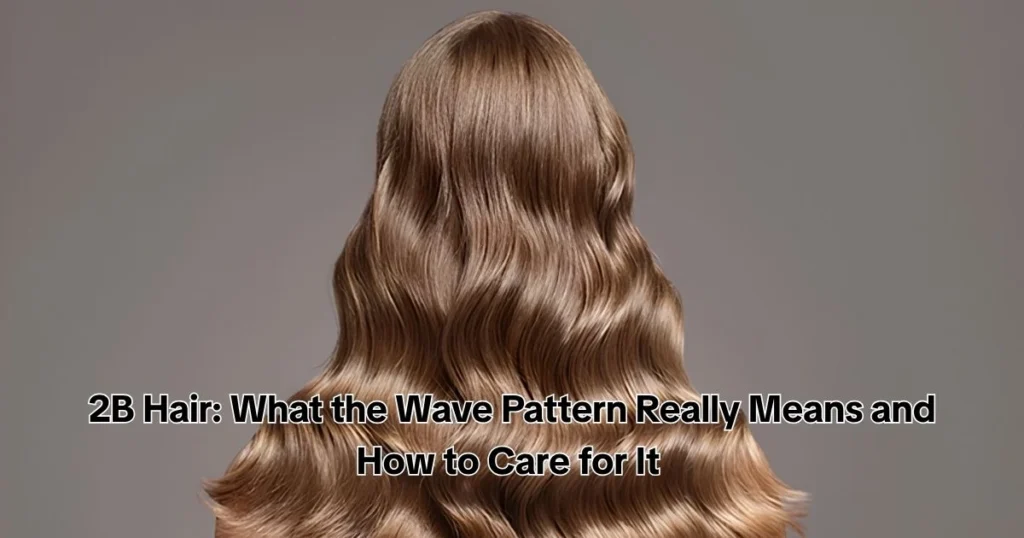
2B hair is a wavy hair type in the Andre Walker hair typing system, marked by loose, S-shaped waves that begin around the mid-shaft and tighten slightly toward the ends. It sits between the barely-there bend of 2A hair and the deeper, more textured 2C pattern. The letter describes the shape of the wave. It does not describe how the hair actually behaves day to day. Porosity does that, and most guides to 2B hair skip it entirely.
This guide covers what the classification actually measures, how to check whether your hair fits it, the routine that keeps 2B waves defined, and a question most extension guides avoid: can you actually buy extensions labeled “2B,” and if not, what should you buy instead?
What Is 2B Hair?
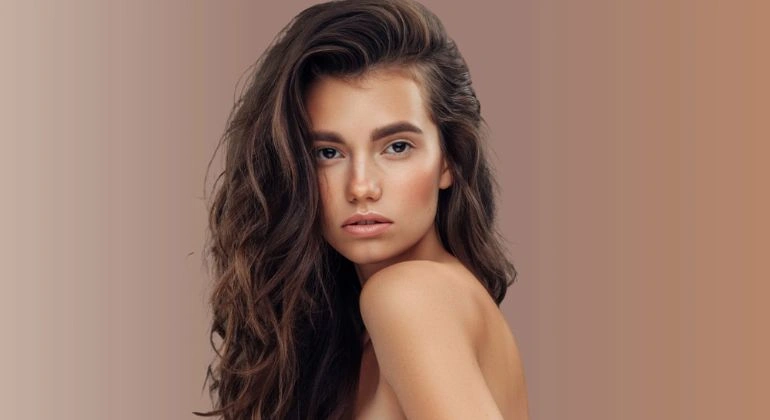
2B falls under Type 2 (wavy hair) in the Andre Walker Hair Typing System, the four-category scale (straight, wavy, curly, kinky) that most hairstylists and product brands still use as shorthand today. Within Type 2, the “B” marks a wave that is more defined than 2A but not as tight or spiral-shaped as 2C.
Where the 2B Label Comes From
The origin is worth knowing, because it explains the system’s limits. Andre Walker, Oprah Winfrey’s longtime stylist, built the chart in the 1990s to market his own hair care line, and it later spread through salons and hair forums as an informal standard, well past its original commercial purpose. Wikipedia’s entry on the Andre Walker Hair Typing System notes it has drawn criticism for treating straighter hair as a baseline and for ranking texture along one spectrum instead of measuring what actually determines how hair behaves.
The scale sorts hair by wave shape alone. It says nothing about strand thickness, density, or how much moisture the hair holds, which is why two people with textbook 2B waves can need completely different care routines.
The Defining Characteristics of 2B Hair
- Wave shape: A consistent S-pattern, usually flat near the root and visible from the midpoint down.
- Volume: Fuller-looking than straight or 2A hair, even with no product.
- Texture: Soft when healthy, swinging between sleek and wavy depending on humidity.
- Frizz behavior: Mild to moderate in humid conditions, concentrated at the crown and part.
- Versatility: Takes a blowout, curl, or straightener with less resistance than curlier types.
How to Tell If You Actually Have 2B Hair
Most hair type quizzes ask you to compare your hair to a photo, which is unreliable since lighting, length, and product buildup all change how a wave photographs. Two better tests take under five minutes.
- The wash-day test. Wash with a gentle shampoo, apply nothing else, and let hair air dry undisturbed. 2B hair shows a loose but visible S-bend, mostly from the ears down, rather than a flat fall or a tight spiral.
- The single-strand test. Pull one clean, dry strand away from the rest and let it hang freely. A 2B strand holds a gentle wave on its own; a straight strand falls flat, and a curlier strand coils.
Hair type is also rarely uniform across one head. The crown often runs looser than the nape, and length pulls waves straighter with added weight, so checking both areas separately gives a more honest picture than judging from the front alone.
2B Hair vs 2A, 2C, and 3A Hair
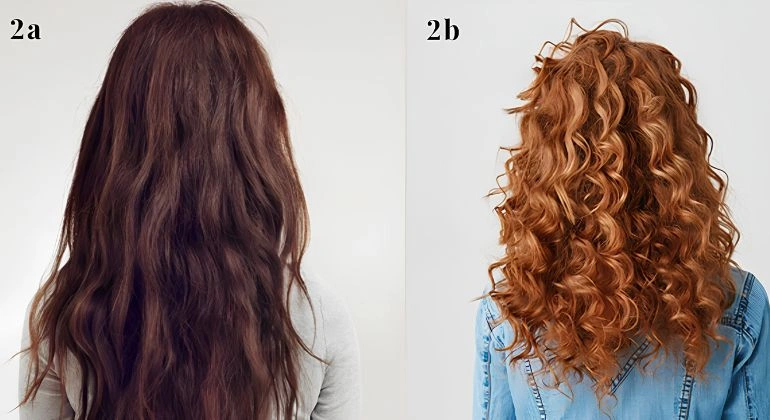
Seeing 2B next to its closest neighbors makes the differences easier to spot than reading descriptions in isolation.
| Hair Type | Wave or Curl Shape | Typical Volume | Frizz Risk | Styling Ease |
| 1A to 1C | No visible wave | Low to medium | Low | Easiest |
| 2A | Faint, loose S starting low | Medium | Low to moderate | Very easy |
| 2B | Defined S, tighter near the ends | Medium to full | Moderate | Easy |
| 2C | Deep S with occasional spiral | Full | Moderate to high | Moderate |
| 3A | Loose, defined spiral curls | Full | High | Moderate to difficult |
2B sits at a genuine midpoint: it holds more shape than 2A without the shrinkage and tangling that come with 2C and 3A. That balance is part of why it is one of the more commonly self-reported hair types, and also why it gets treated as a “safe” default when people are unsure which category they fall into.
Why Porosity Matters More Than the Letter
Porosity describes how easily your hair’s outer cuticle lets moisture in and out, and it has nothing to do with wave pattern. Two people with identical 2B waves can have opposite porosity, which is why “just follow the 2B routine” is often bad advice.
Check Your Porosity in Under a Minute
Drop two or three clean, product-free strands into a glass of room-temperature water and watch what happens.
| What You See | Porosity Level | What It Means for 2B Hair |
| Strand floats near the surface | Low | Cuticle is tightly sealed. Waves hold shape well but products sit on top instead of absorbing; use lighter, water-based formulas and apply to damp hair. |
| Strand sinks slowly, settles mid-glass | Medium | The balanced zone. Most standard wavy-hair routines, including the one below, work as written. |
| Strand sinks quickly to the bottom | High | Cuticle is raised or damaged, often from color or heat. Waves absorb humidity fast and drop or frizz quickly; richer leave-ins and more frequent deep conditioning help. |
This single test explains more about how your 2B hair will actually behave in a humid August in Hanoi versus a dry winter than the wave-shape classification ever will.
How to Care for 2B Hair: A Routine Based on What Actually Works
Wash Less Often, With a Sulfate-Free Formula
Board-certified dermatologists at the American Academy of Dermatology note that textured and wavy hair is more prone to dryness and breakage than straight hair, and recommend washing only as often as your scalp needs it rather than on a fixed daily schedule. For most 2B hair, that lands around two to three washes a week with a sulfate-free formula that cleans without stripping the oils that keep waves defined.
Pre-Wash Oiling Has Real Evidence Behind It
Coconut oil is the one pre-wash treatment with published data behind it, not just tradition. A study by Rele and Mohile in the Journal of Cosmetic Science compared coconut, mineral, and sunflower oils applied before washing and found coconut oil was the only one that measurably reduced protein loss from the hair shaft in both damaged and undamaged hair, in some conditions by close to 40 percent. Its low molecular weight lets it penetrate the strand rather than just coat it, limiting how much the cuticle swells and chips during washing. The effect was measured from applying oil to dry hair fifteen to thirty minutes before shampooing, not as an after-wash treatment.
Detangle Wet, Dry Smart
Wet 2B hair is at its most fragile, so detangle with a wide-tooth comb or your fingers, working from the ends upward rather than dragging a brush from root to tip. If you wear extensions or a wig alongside your natural hair, our guide on how to dry hair extensions like a pro covers the airflow and sectioning that gets a weft fully dry at the root without frizzing the wave on the way.
Manage Heat and Humidity Instead of Fighting Them
The AAD’s guidance on preventing damage from weaves and extensions recommends the lowest heat setting that still gets the result you want, and limiting how long a hot tool touches any one section. For frizz specifically, swap heavy oils and creams for a lightweight mousse or anti-humidity spray; heavy products weigh a 2B wave down and pull it straight within hours, the opposite of what most people reach for them to fix. More general strategies live in the AAD’s healthy hair tips resource.
Hairstyles That Work With 2B Waves, Not Against Them
The styles that photograph best on 2B hair are the ones that use the existing wave instead of fighting it flat or over-curling it into a different pattern.
- Long layers. Removing weight from the ends lets the S-bend show through instead of getting pulled straight.
- Curtain bangs. Face-framing pieces fall into the wave naturally, needing almost no separate styling.
- The wolf cut. Heavy crown layering adds volume where 2B hair is usually weakest.
- Half-up styles. Front sections pulled back show off the wave through the lengths without a full updo.
- Low-maintenance beach waves. Texturizing spray on damp, air-dried hair exaggerates the pattern with no hot tool.
For a broader look at which cuts and lengths pair well with wavy textures this year, our 2026 hairstyle guide matches specific cuts to hair type and face shape.
Matching Hair Extensions to 2B Waves: The Part Most Guides Get Wrong
Here is what most “best extensions for 2B hair” articles skip: the Andre Walker system describes how hair grows out of a scalp. It is not a grading standard hair suppliers use for wefts, bundles, or closures, since a bundle has no follicle and no natural growth pattern to measure. If a listing claims an exact “2B texture” bundle, treat that as marketing language, not a technical spec. What you are actually choosing between are two honest paths to a texture that reads as 2B once it is installed.
Path One: Style a Straighter Bundle Into a Fine 2B Wave
For the closest match to a fine, delicate 2B pattern, a straight or lightly wavy bundle styled with a low-heat wand or overnight flexi-rods gives the most control over wave size. Our mermaid waves guide walks through the tool choices and cooling technique that decide whether a styled wave holds through the day, and the same mechanics apply to a soft 2B bend as to a dramatic mermaid pattern.
Path Two: Start From a Pre-Textured Wavy Bundle
If daily styling is not something you want to add to your routine, a bundle that already carries a wave pattern needs less work. Our own Raw SEA Wavy Bundle is worth naming honestly here: its texture runs slightly fuller and coarser than a delicate 2B wave, closer to a body-wave finish out of the packet. It suits fuller-volume waves with minimal effort, and it can be relaxed into a finer bend with a flat iron on low heat if you want it closer to true 2B. It is not a one-to-one match to fine natural 2B hair straight out of the bag, and we would rather say so than have a bundle arrive and miss what you pictured.
Why Raw, Unprocessed Hair Holds Either Style Longer
Whichever path you choose, processing history affects how long the result lasts. Hair with an intact, unstripped cuticle resists letting humidity back in, so a styled or natural wave holds longer between touch-ups. Chemically stripped hair sold under vague “virgin” labels without real single-donor sourcing has a rougher cuticle that lets moisture back in faster and drops a wave sooner. Our guide to what “virgin” hair extensions actually means covers how to verify a bundle’s cuticle before you buy, rather than taking the label at face value.
Not sure which path fits your natural hair? Contact our team with a photo. Texture matching is easier in a five-minute conversation than in a guessing game with a product listing.
The Bottom Line on 2B Hair
2B tells you the shape of your wave. Porosity tells you how that wave actually behaves, and it is worth five minutes with a glass of water to find out before committing to a product routine or an extension order based on the letter alone. Start with what your hair does, not what a 1990s marketing chart calls it.
Have a photo of your natural texture and want a straight answer on whether our Raw SEA Wavy Bundle or a styled straight bundle is the closer match? Contact Raw Hair Luxury for a texture consultation, or browse the full collection of raw human hair extensions to compare options side by side.
Ready to find your perfect match? Contact us today for expert advice and exclusive discounts on premium human hair extensions.
📲Phone/WhatsApp: +1 (206) 698‑5133
🛜Instagram: RAW HAIR LUXURY COMPANY
🌐Tik Tok: RAW HAIR LUXURY
📧 Email: Rawhairluxury.us
🌐Website: rawhairluxury.com

One Reply to “2B Hair: What the Wave Pattern Really Means and How to Care for It”
Body Wave vs Deep Wave: The Real Difference
[…] reads as closer to a natural 2A to 2B wave pattern, the loose, barely-there bend documented in our 2B hair guide, which is why it blends seamlessly with straighter natural hair and photographs as understated […]