


A winter hair care routine replaces the moisture that cold, dry air pulls out of the hair shaft and cuts the friction that snaps brittle strands. The five moves that matter: wash less often, condition every wash, stop the multi-hour air dry, cover your hair outdoors, and hold indoor humidity between 30 and 50 percent. Below is the reasoning behind each one, plus the part almost every winter hair care guide gets backwards.
Most seasonal advice stops at “use a mask and wear a hat.” That leaves out why your hair feels like straw in January, why breakage clusters at the nape of your neck, and what changes if you wear wefts, tape-ins, or a wig. This guide covers all three, with sources you can check.
Cold weather hair damage: what it does to the hair shaft
Cold weather hair damage is moisture loss plus mechanical friction. Your hair is hygroscopic, meaning it trades water with the air around it. Keratin strands bond to water molecules through hydrogen bonds, and as Smithsonian Magazine explains, humid air lets a strand form far more of those bonds than dry air does. Winter runs that process in reverse. Cold outdoor air holds little water, and indoor heating strips out more.
The result is a strand with less internal water, a stiffer cortex, and cuticle scales that lift instead of lying flat. Lifted scales catch on each other, on scarves, and on your coat collar. That is the friction half of the problem, and it is why winter hair breakage shows up where fabric touches hair.
Why dry winter air pulls moisture out of the hair shaft
Indoor heating is the bigger culprit, not the weather outside. The US Environmental Protection Agency advises keeping indoor relative humidity below 60 percent and ideally between 30 and 50 percent. Forced-air heat routinely drives a sealed home well under 30 percent through the winter. Your hair spends most of its day in that air, not outdoors.
Low humidity has a second effect beyond dryness: static. With fewer water molecules available to dissipate surface charge, strands repel each other, lift, and tangle. Static flyaways are a readout of the air in your house.
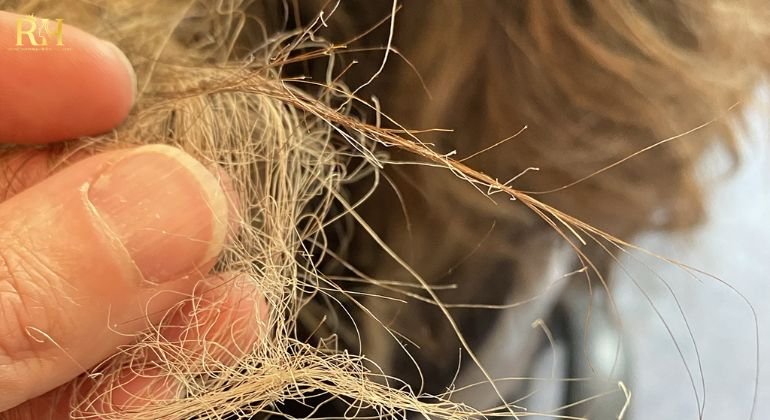
Why winter hair breakage happens at the cuticle
The cuticle is the armor, and it is thinner than most people assume. In her review in the International Journal of Trichology, Dr. Maria Fernanda Reis Gavazzoni Dias reports that the cuticle is formed of roughly six to eight overlapping scale layers in Asian hair, slightly fewer in Caucasian hair, and fewer again in African hair. Once those layers wear through, the cortex is exposed and the damage is permanent.
Elasticity data from the same review shows how little margin dry hair has. Wet virgin hair stretches about 30 percent of its length without damage. Between 30 and 70 percent the change becomes irreversible, and at 80 percent the strand fractures. Winter-dry hair reaches those thresholds sooner, which is why a brush that felt fine in August starts leaving short broken pieces in the sink in January.
Dias also flags hygral fatigue, the repeated swelling and drying of the shaft, as a damage mechanism in its own right. That matters for the next section.
The 7-step winter hair care routine
Each step targets either moisture loss or friction. Run all seven for a full winter hair care routine, or start with the first three if you want the highest return for the least effort.
1. Wash less, and wash the scalp only
- The American Academy of Dermatology advises matching frequency to hair type: oily straight hair may need daily washing, while dry, textured, curly, or thick hair can go every two to three weeks. Apply shampoo to the scalp, not down the length. The lengths get cleaned by the runoff.
2. Condition every single wash
- Fine or straight hair: ends only. Dry or curly hair: all the way through. Conditioner lays the cuticle flat, which is the friction fix and the shine fix at the same time.
3. Add one weekly deep conditioning treatment
- Thirty minutes under a cap beats a five-minute rinse-out. Keep it to once a week. Soaking dry hair daily drives the hygral fatigue cycle Dias describes.
4. Detangle wet hair the slow way
- Wide-tooth comb, never a brush, working from the ends upward in sections. Wet hair is at its most stretchable and its most fragile at the same moment.
5. Blot, do not rub
- Wrap in a cotton t-shirt or a microfiber towel. Terry cloth rubbing lifts cuticle scales that winter air has already loosened.
6. Cover your hair outdoors, with the right lining
- A wool hat protects against cold and abrades hair at the same time. A silk or satin lining gives you the protection without the friction. The same applies to a scarf worn against the nape.
Winter hair care for extensions, wefts, and wigs
This is the part general guides skip, and it is the part that costs the most money. Extensions and wigs receive no sebum. Your scalp produces oil that travels down your own strands as a natural conditioner, and installed hair is cut off from that supply entirely. Every bit of moisture in an extension is moisture you put there. In a 25 percent humidity living room, that deficit compounds week by week.

Four adjustments for winter:
- Seal the mid-lengths and ends daily. A light leave-in or a few drops of oil on the lengths, never at the attachment points, where buildup causes slippage on tape-ins and matting on wefts.
- Protect the nape. Coat collars and scarves ride directly over the bottom rows. This is where matting starts. A silk scarf as the base layer, with the wool over it, solves the problem.
- Never sleep on wet installed hair. Braid loosely or twist, use a silk pillowcase, and make sure the attachment points are dry before bed. Damp bonds and damp tape are the fastest route to slippage.
- Store wigs on a stand, not in a drawer. Folded storage in dry air sets creases that no amount of conditioning reverses.
Why raw hair extensions hold up better in dry winter air
Processing grade predicts winter performance better than country of origin does. The cuticle is the moisture barrier, so anything that strips or damages it leaves hair that dries faster and tangles sooner.
Raw hair is collected from a single donor and sold without chemical processing, with the cuticle intact and all strands running in the same direction. Virgin hair is unprocessed but may be blended from multiple donors. Remy hair has aligned cuticles but has often been colored or texturized. Non-Remy hair has typically been acid-stripped of its cuticle and coated in silicone, which washes off and leaves bare cortex exposed. That last category is where winter tangling complaints concentrate.
Honest framing: raw hair is not immune to winter dryness. It starts with a better barrier and therefore holds a deep conditioning treatment longer, but it still needs the routine above. Any vendor claiming their hair needs no winter care is selling a story. If you want the full breakdown, see our guide to raw vs virgin vs Remy hair grades and our hair extension care guide.
Build your winter routine on hair that can take it
A routine only works on hair with a cuticle left to protect. If you are a salon owner, stylist, or reseller sourcing for winter, we can show you the difference between raw and processed hair in your own hands rather than on a product page.
Request a wholesale sample pack from Raw Hair Luxury and test it through a full wash, condition, and dry cycle before you commit to an order.
📲Phone/WhatsApp: +1 (206) 698‑5133
🛜Instagram: RAW HAIR LUXURY COMPANY
🌐Tik Tok: RAW HAIR LUXURY
📧 Email: Rawhairluxury.us
🌐Website: rawhairluxury.com