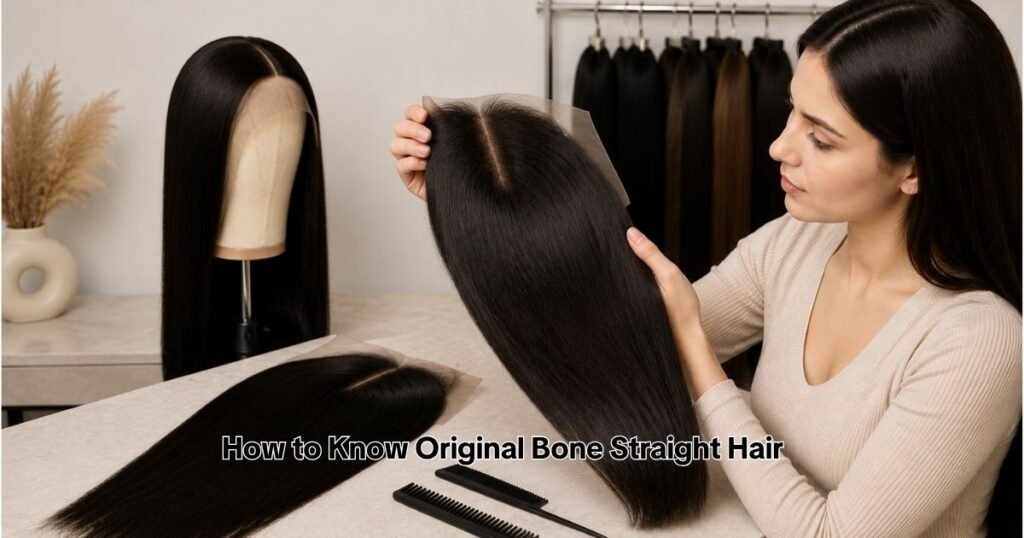
You can verify original bone straight hair with six physical checks: a wash-and-air-dry test, a feel test, a heat reversion test, a squeeze test, a root-to-tip cuticle glide test, and a burn test. Each one targets a different part of hair’s chemistry, so knowing why a test works matters as much as running it, because that’s the part a vendor selling fake hair is counting on you never learning.
What Actually Makes Hair “Bone Straight”?
Bone straight is a processing outcome, not a hair type. It’s human hair, usually raw or virgin grade, steamed and pressed into a uniform, flat-iron-finish texture that holds pin-straight through washing and normal wear. Because it’s something done to hair rather than something a donor’s hair naturally is, almost any starting material can be pushed into that look, including lower-grade or synthetic-blended hair coated to fake the same glassy finish.
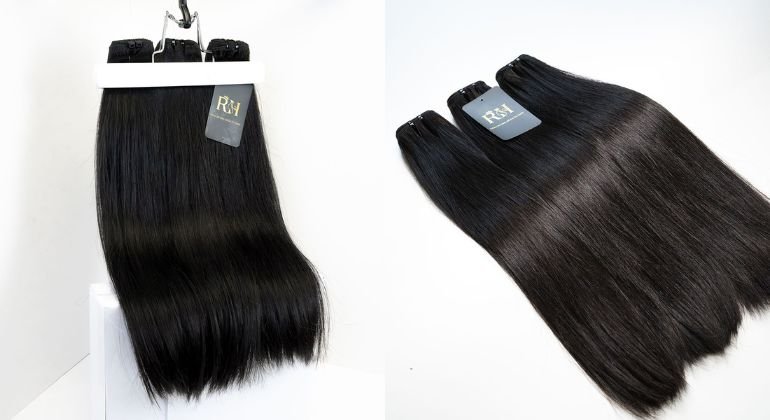
Genuinely raw straight hair is different: naturally straight from a single donor, never steamed for uniformity, so bundle-to-bundle variation is normal rather than a defect. Our grading guide to Vietnamese hair bundles breaks down how that steam-processed, uniform texture most often shows up in Chinese-processed hair sold under the bone straight name, while Vietnamese and Cambodian donor hair more commonly ships in its natural straight or wavy state. Neither claim is interchangeable, and a listing that blurs the two is the first thing worth questioning.
The Chemistry Behind Every Verification Test
Every test below works because of two bonds inside keratin: hydrogen bonds and disulfide bonds. Hydrogen bonds are weak and break the moment hair gets wet, then reform in whatever position it dries, the same mechanism behind any blowout or flat-iron set (McGill Office for Science and Society). Disulfide bonds, built from sulfur bridges between cysteine amino acids, are far stronger and only break under sustained heat or chemical treatment, not a single wash.
That’s why a proper bone straight set survives water and a fake one doesn’t. Genuine steam processing works the structure hard enough that the trained shape holds even after hydrogen bonds reset in a wash. Hair only coated in silicone has no such set behind it: the shine rinses off, the hydrogen bonds reform around whatever kink was underneath, and it reverts. The cuticle matters just as much. It’s the outermost, shingle-like layer of cells that controls shine and friction between strands (NCBI StatPearls, Histology of Hair and Follicle), and a peer-reviewed friction study measured a real, directional rise in resistance when a strand is stroked against its scales rather than along them (Advances in Colloid and Interface Science). That directional friction is what the root-to-tip glide test measures, and why stripped or flattened cuticles feel identical in both directions.
The 6-Point Verification Checklist: How to Test Bone Straight Hair at Home
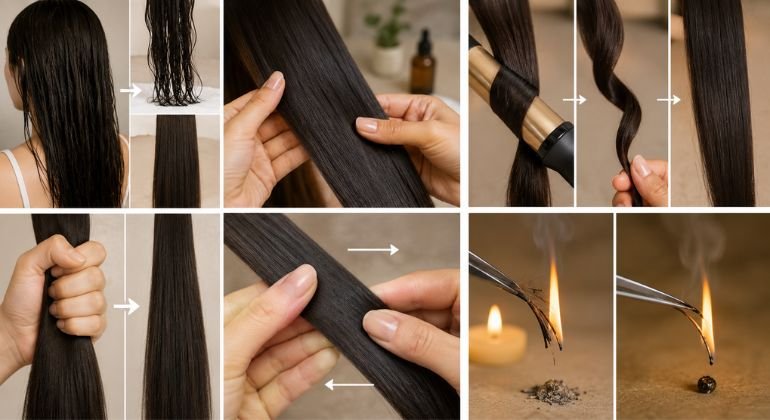
- Wash-and-air-dry test. Wash a small section with no styling product and let it dry undisturbed. Genuine bone straight hair falls flat and pin-straight on its own. Fake or low-grade hair puffs, waves, or frizzes as the water resets the hydrogen bonds around whatever texture is underneath the coating.
- Feel test. Run a section through your fingers once it’s dry. Real bone straight hair feels silky and slightly cool, with natural weight and give. Waxy, sticky, or artificially glassy strands usually mean a silicone or acrylic coating rather than an intact cuticle.
- Heat reversion test. Wrap a small section around a curling iron for a few seconds, then release it. Authentic hair holds the curl only briefly before relaxing back toward straight, because the strand’s trained structure is still dominant. Hair that holds the curl indefinitely, or that frays and won’t hold any shape at all, has usually been damaged past the point of returning to its set pattern.
- Squeeze test. Grip a bundle firmly in your fist and release. Original bone straight hair springs back flat with no visible kinking. Lower-grade or synthetic-blended sections often show a faint crimp exactly where your fingers gripped it.
- Root-to-tip cuticle glide test. Slide two fingers along a strand from root to tip, then reverse direction. Intact, aligned cuticles feel smoother moving one way and slightly rougher the other, a friction difference confirmed in fiber research cited above. If the strand feels identical in both directions, the cuticle has likely been chemically stripped or was never aligned to begin with.
- Burn test. Snip a couple of strands, hold them with tweezers away from your face, and light the ends. Real human hair singes slowly, smells like burning protein, and crumbles into fine ash. Synthetic fiber melts fast, smells like burning plastic, and hardens into a bead. This test tells you whether you’re holding human hair at all, but it says nothing about donor sourcing or drawn grade, so pair it with the tests above rather than treating it as the only check that matters.
Ask any vendor to run these on video before you commit to a bulk order, and treat a refusal as a red flag on its own. For everything these tests don’t cover, particularly single-donor sourcing claims, our guide to what “virgin” actually means walks through the consistency checks that catch blended or relabeled hair.
Red Flags: How to Spot Fake or Low-Grade Bone Straight Hair
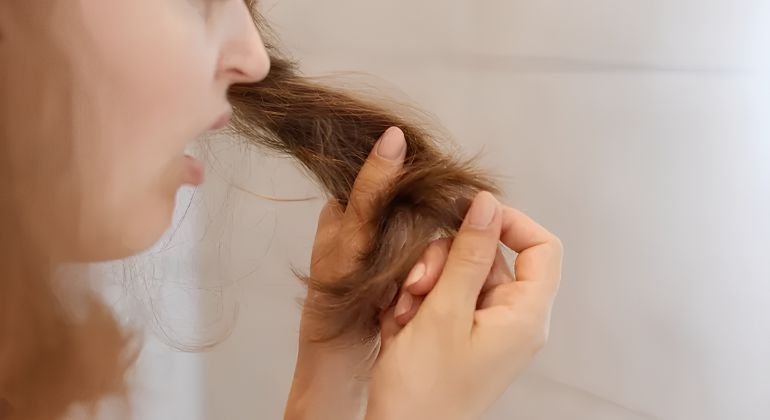
- Unnatural plastic shine. Genuine bone straight hair has a soft, shifting luster. A hard, glassy shine that looks identical from every angle usually points to a silicone coating.
- Tangling and shedding at the nape. Heavy shedding on a new bundle, or fast matting near the neck, signals mixed-donor sourcing or a cuticle that was never properly aligned.
- Reversion after the first wash. If straightness disappears the moment the bundle meets water, the flat finish was a styling effect layered on top, not a real steam set.
- Every bundle looks identical. Genuinely raw and virgin hair comes from individual donors, so subtle variation between bundles in the same order is normal, even after processing. A large order where every bundle is a pixel-perfect match more often points to synthetic uniformity than to unusually careful sourcing.
- The vendor won’t show an unwashed sample. A seller confident in their sourcing can show raw, uncoated hair next to the finished bundle so you can see where the shine actually comes from.
| Characteristic | Original Bone Straight | Fake or Low-Grade |
| Texture | Silky, cool to the touch, natural weight | Waxy, oily, or artificially stiff |
| Cuticle glide (root-to-tip) | Noticeably smoother one direction than the other | Feels identical or rough in both directions |
| Curl retention | Rejects curls, relaxes back to flat within moments | Holds curls for hours, or frays and won’t hold shape |
| Wet behavior | Dries straight with no frizz or puff | Waves, frizzes, or visibly expands after washing |
| Bundle-to-bundle consistency | Slight, natural variation between bundles | Suspiciously identical across an entire order |
| Burn result | Singes slowly, smells like burnt protein, turns to ash | Melts fast, smells like plastic, hardens into a bead |
Original Bone Straight vs Raw Straight: Which Should You Actually Buy?
This question matters more than any single verification test. Bone straight is a manufactured finish: hair steamed into a uniform, glass-flat pattern so every bundle matches. Raw straight hair is the donor’s natural texture with no steam processing, so it holds up honestly to every test above but shows gentle strand-to-strand variation rather than a showroom-uniform finish out of the package.
For a large sew-in or wig where every bundle needs to match on day one, a transparently sourced bone straight bundle is the more predictable choice. For hair you’ll restyle later into waves or curls, unprocessed raw straight is more versatile, and you can flat-iron it pin-straight yourself whenever you want that look. Our Raw SEA Straight bundle falls in this second category: naturally straight, single-donor sourced, never steamed for uniformity. For the full grading breakdown, see our ultimate guide to raw hair.
What Should Original Bone Straight Hair Actually Cost?
Pricing scales with length and drawn grade (single, double, and super double drawn, which describe how consistently a bundle holds its length and thickness top to tip). Industry pricing commonly cited across US wholesale and retail listings puts bone straight bundles roughly $35 to $70 per 100g for shorter single-drawn lengths, up to $100 to $200+ per 100g for long, super double drawn bundles, though exact numbers vary by vendor and season. Treat “luxury” or “super double drawn” bone straight priced like standard synthetic-blend hair as a near-certain red flag. Authentic sourcing and steam processing cost real money, and no legitimate vendor gives that away at a discount.
Verify Before You Buy
Authenticity in this category isn’t a guessing game once you know what to test and why each test works. Run the six checks above on video with any new vendor, ask direct questions about single-donor sourcing and processing, and treat a refusal to demonstrate quality as the clearest red flag there is. If you’d rather see single-donor, cuticle-intact hair in person before you order, contact our team for current stock and sample options, or review our warranty and returns policy, available in writing before you pay.
Ready to find your perfect match? Contact us today for expert advice and exclusive discounts on premium human hair extensions.
📲Phone/WhatsApp: +1 (206) 698‑5133
🛜Instagram: RAW HAIR LUXURY COMPANY
🌐Tik Tok: RAW HAIR LUXURY
📧 Email: Rawhairluxury.us
🌐Website: rawhairluxury.com