

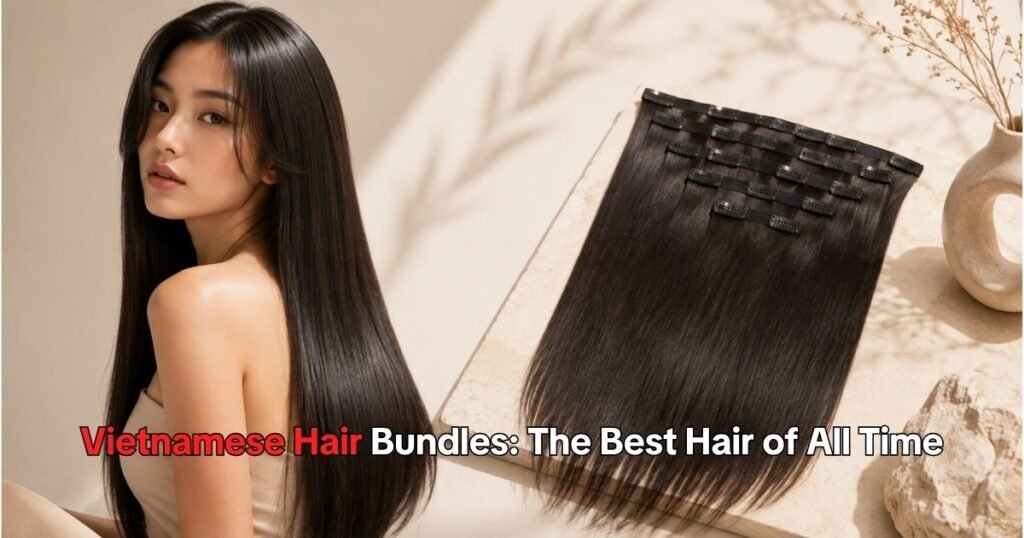
Vietnamese hair bundles are wefts or loose bulk hair collected from individual Vietnamese donors, prized for naturally thick strands and, in raw form, fully intact cuticles. That combination is why they hold color, resist shedding, and outlast many lower-grade alternatives. But “Vietnamese hair bundles” is a sourcing label, not a quality grade, and most buyers never learn the difference until a bundle mats after six washes. This guide breaks down what the grading terms actually mean, how to verify quality before you buy, and how to make a bundle last.
What Are Vietnamese Hair Bundles, Exactly?
Vietnamese hair bundles are human hair extensions sourced from women in Vietnam, most commonly from rural and highland provinces where long, uncolored hair is more common. The hair is collected either as bulk hair (loose strands, sold by weight) or as a weft, where strands are sewn onto a fabric track for direct installation.
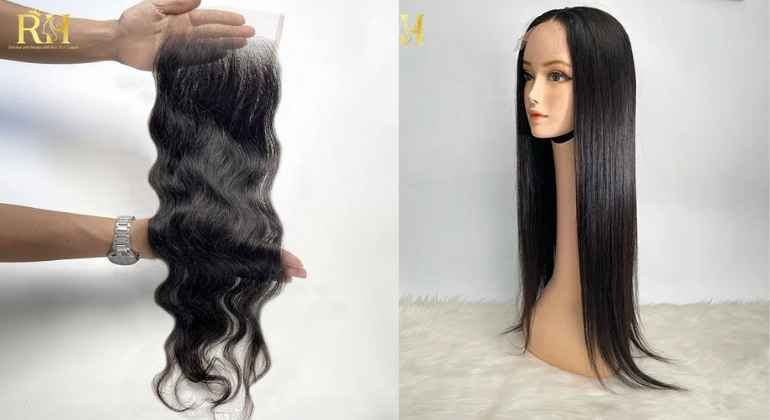
Two sourcing patterns matter more than the country label itself:
- Single-donor bundles come from one person’s cut, so color, texture, and thickness stay consistent from the first bundle to the fourth.
- Multi-donor (blended) bundles combine hair from several donors to hit a length or weight target, which can introduce mismatched cuticle direction and uneven texture even when every strand is genuinely human hair.
Neither pattern is exclusive to Vietnam, but Vietnam’s smaller-scale, individual-seller collection model makes single-donor sourcing more common there than in bulk-collection markets, a point worth understanding before you compare origins later in this guide.
Raw vs Remy vs Virgin: The Terminology Most Sellers Skip
These three words get used almost interchangeably in hair bundle listings, and that’s where most buyer disappointment starts. They describe two separate things: how much the hair has been chemically altered, and whether the cuticles are intact and running in one direction.
| Grade | Cuticle Status | Chemical Processing | Donor Source | Relative Cost |
| Raw / True Virgin | Fully intact, aligned root-to-tip | None; not even washed with harsh detergents | Always single donor | Highest |
| Virgin | Intact, aligned | Unaltered color/perm, but commercially washed and conditioned | Usually single donor | High |
| Remy | Intact, aligned in one direction | May be steamed, lightly colored, or coated to enhance shine | Single or multiple donors | Mid |
| Non-Remy | Not aligned; mixed direction | Often heavily processed to mask irregular cuticles | Multiple, uncontrolled | Lowest |
The practical takeaway: “remy” is a claim about alignment, not purity. A bundle can be labeled remy and still have been steamed or silicone-coated to fake the smoothness that raw hair has naturally. If a listing calls hair “raw” but doesn’t mention single-donor sourcing, ask directly, because raw hair without single-donor sourcing is a contradiction in terms.
Why Cuticle Alignment Is the Real Quality Marker
Sellers describe cuticle alignment as a luxury feature, but it’s actually a friction problem with a measurable cause. Hair fiber researchers who study tribology (the physics of surfaces in contact) have measured how the direction of cuticle scales changes friction along a strand, recording a meaningful rise in friction force when hair moves root-to-tip against the cuticle scales compared with moving in the same direction as the scales, according to a peer-reviewed hair friction study published in Advances in Colloid and Interface Science. In practice, that friction is what you feel as tangling: every scale sitting the wrong way is one more point where adjacent strands catch on each other.
This is also why non-remy hair, even genuine human hair, tends to mat faster: strands from different donors or reversed during collection have cuticles pointing in conflicting directions, so every wash and every wear cycle adds friction instead of letting strands glide past each other. Hair fiber structure research describes the cuticle as a layered, overlapping sheet surrounding the central cortex, which is the physical reason a damaged or misaligned cuticle changes how the whole strand behaves under stress, not just how it looks.
How to Verify Quality Before You Buy
You can’t run a lab test in a DM thread, but these four checks catch most misrepresented hair before it reaches your cart:
- Ask for a burn test on video. Genuine human hair singes, curls away from the flame, and smells like burning protein (similar to burnt hair on your own head). Synthetic fiber melts into a hard bead and smells like burning plastic. A reputable seller will do this on request.
- Run the finger-glide test. Pinch a small section and slide your fingers from root to tip, then tip to root. Aligned, intact cuticles feel smoother moving root-to-tip and slightly rougher moving the opposite way. If it feels identical (or rough) in both directions, the cuticles are likely stripped or misaligned.
- Check wet behavior, not just dry shine. Wet a small section and watch how it dries. Hair that’s been silicone-coated to fake a “raw” look will lose its shine and feel noticeably rougher after a few washes, since the coating rinses away and the underlying processed cuticle is exposed.
- Weigh what you receive. A bundle sold as 100g should weigh close to 100g on a kitchen scale, wefted material included. Consistent underweight bundles across an order is a common sign of a reseller padding margins rather than a factory-direct source.
None of these tests is conclusive alone, and treat single-test claims (from any seller, including this one) with some skepticism, but a vendor willing to demonstrate two or more of them before you buy is a stronger signal than any product description.
Bundle Types, Weight & How Many You Need
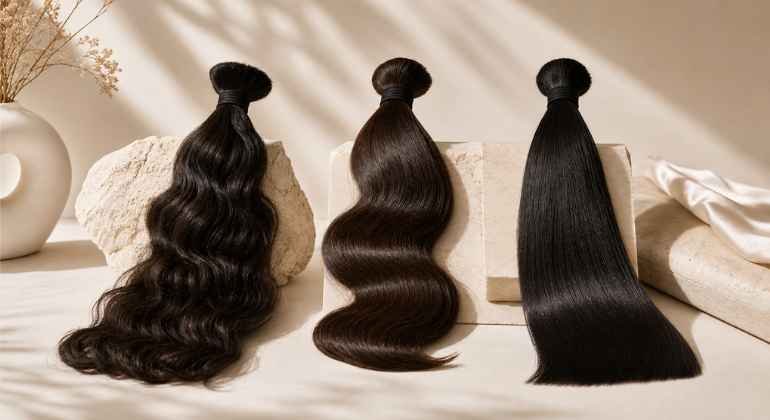
Vietnamese hair bundles come in two working formats. Bulk hair is loose and unattached, giving you full control for braiding, crochet styles, or hand-tied wig construction. Weft hair is machine- or hand-sewn onto a fabric track, ready to install directly for a sew-in like a straight Raw SEA bundle or a wavy install.
A standard machine weft bundle runs about 100g, though hand-tied wefts and specialty cuts vary. As a starting reference for a full sew-in or wig base:
- Shorter lengths (10 to 16 inches) or moderate volume: 2 to 3 bundles
- Mid-to-long lengths (18 to 24 inches) or fuller styles: 3 to 4 bundles
- Very long or extra-full styles (26 inches+): 4 to 5 bundles, plus a closure or frontal
These are starting points, not fixed rules. Natural hair density and how tight you want the finished look both shift the count up or down.
Matching Grade and Format to Installation Method
The right hair grade depends on how it’s going on your head or your client’s. Sew-ins and quick weaves generally call for wefted bundles, either straight or wavy machine weft, since the track needs to sit flat under natural hair. Full or partial wig-making typically pairs wefts with a closure or frontal to finish the parting. Clip-ins and tape-ins have different prep and wear-time considerations entirely; if you’re deciding between the two, this comparison of clip-in vs tape-in extensions breaks down which suits your lifestyle.
Vietnamese Hair vs Other Origins at a Glance
| Origin | Natural Texture | Typical Thickness | Natural Wave | Best For |
| Vietnamese | Straight to soft wavy | Medium to thick | Common, especially highland-region donors | Sleek installs, everyday wear, heat styling |
| Indian (temple/donated) | Wavy to curly | Fine to medium | Frequent | Voluminous curly or wavy styles |
| Cambodian | Wavy | Medium | Common | Beachy waves without heat tools |
| Chinese-blend/processed | Bone straight (often steam-processed) | Coarse, frequently treated to appear finer | Rare in natural state | Budget straight styles, shorter-term wear |
No origin is universally “best.” Vietnamese hair’s reputation comes from a middle ground of thickness and manageability that works for both sleek and lightly wavy finishes without heavy processing, which is also why it takes color and heat styling predictably when it starts out raw or virgin grade.
Caring for Vietnamese Hair Bundles to Maximize Lifespan
Grade and sourcing set the ceiling on how long a bundle can last; care determines whether you actually get there. Wash with sulfate-free products, dry with low direct heat rather than high-speed rough drying (a proper drying routine matters more than most buyers expect), and detangle from the ends upward before working toward the root. Bundles that start shedding early are often a styling or storage issue rather than a hair-quality one; if that’s happening, this guide on stopping wig and bundle shedding covers the most common causes.
Choosing Where to Buy
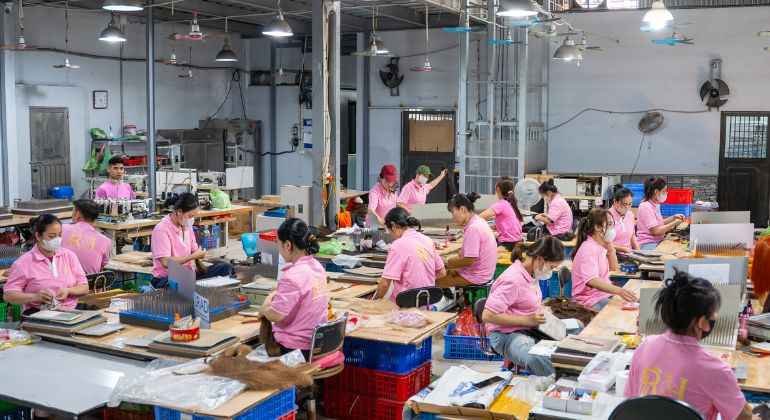
The grading and verification framework above works regardless of who you buy from, and that’s the point: it’s meant to help you evaluate any vendor, including us. If you want to see single-donor, cuticle-aligned Vietnamese bundles in person before committing to a wholesale order, reach out to our team for current stock, pricing, and sample options.
Ready to find your perfect match? Contact us today for expert advice and exclusive discounts on premium human hair extensions.
📲Phone/WhatsApp: +1 (206) 698‑5133
🛜Instagram: RAW HAIR LUXURY COMPANY
🌐Tik Tok: RAW HAIR LUXURY
📧 Email: Rawhairluxury.us
🌐Website: rawhairluxury.com

One Reply to “Vietnamese Hair Bundles: The Best Hair of All Time”
Vietnamese Hair Has a High Natural Density - Raw Hair Luxury
[…] For a deeper look at bundle construction and quality grades, see our Vietnamese Hair Bundles guide. […]